Existing Spend → AI Price Collapse: compliance evidence packs
Compliance-heavy SMEs do not pay to be compliant once; they pay to re-prove it over and over. AI is collapsing the price of the proof, not the price of the responsibility.
17 June 2026
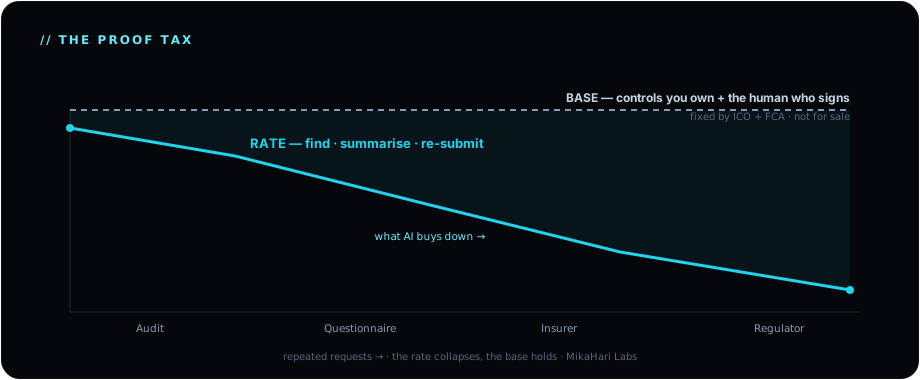
The Proof Tax is the recurring cost of re-evidencing controls you already hold. The FSB's "Playing by the Rules" report sizes the wider regulatory compliance burden on smaller firms at roughly £36 billion and 379 million hours a year [1]. That is the repeated cost in a compliance-heavy SME: not getting compliant once, but re-proving the same controls every time an auditor, regulator or customer asks. AI is collapsing the rate of that tax by automating evidence retrieval and questionnaire reuse, and Vanta drafts up to 80% of a security questionnaire automatically [4]. What it cannot collapse is the obligation underneath: as a matter of good governance, a responsible, competent person should still review and own the control and the answer, and the ICO and FCA expect outcomes to be evidenced [2][3].
Finding, summarising and re-submitting the same control evidence for every audit, customer questionnaire and supplier request. The FSB's "Playing by the Rules" report sizes the regulatory compliance burden on smaller firms at roughly £36 billion and 379 million hours a year.
You don't pay to be compliant. You pay to keep proving it.
A 40-person fintech in Leeds passes a SOC 2 audit in March. In April a prospect's procurement team sends a 220-question security questionnaire. In May the ICO's accountability expectations come up in a board pack. In June a banking partner asks for the same incident-response evidence the auditor saw twelve weeks earlier. Four requests, one underlying truth about the business, and the team rebuilds the answer four times from the same scattered folders. Nobody became more compliant in those four months. They just kept paying to demonstrate a thing that was already true.
Here is the bet this briefing will lose on if it is wrong. Most compliance-AI pitches sell you a drafter, a model that writes your policies and frameworks. We think the first durable payback is the opposite end of the workflow: the dull, repeated act of re-evidencing controls you already have. If the market reprices policy-writing faster than it reprices evidence-retrieval, we are wrong. Watch where Vanta, Drata and Conveyor actually point their automation and you'll see the answer. They lead with evidence collection and questionnaire reuse, not prose [4][6][7].
“Nobody became more compliant in those four months. They just kept paying to demonstrate a thing that was already true.”
What this means: The recurring cost is re-proving controls you already hold — that is the line AI can buy down.
What is the Proof Tax, and why does it bite?
Give the cost a name and it stops being background noise. The Proof Tax is the recurring price of re-evidencing controls you have already implemented. Like any tax it has two parts: a base (the controls you must hold) and a rate (how often, and how laboriously, you re-prove them). The base is fixed by your sector and your size. The rate is set by how many auditors, regulators, insurers and customers ask, and by how badly your evidence is filed when they do. The rate is the part that bites, and the part finding, summarising and re-submitting evidence makes worse.
UK smaller firms spend an estimated £36 billion and 379 million hours a year on compliance [1][10]. That is the FSB's "Playing by the Rules" measure of the base. But the tax that bites a compliance-heavy SME is the rate: the same SOC 2 control evidenced for the audit, then again for three customer questionnaires, then again for an insurer. The 2025/26 cyber-security supplier ask makes this concrete. Due-diligence packs routinely demand evidence of MFA, patching, incident-response plans and certificates — the same controls, re-evidenced for every buyer who asks. Same controls. Wildly different rate.
Why is the proof rate collapsing now?
The thing AI is genuinely good at is the thing the Proof Tax is made of: retrieval, summarisation and reuse across a messy pile of documents. That is why the GRC platforms have converged on it. Vanta says its agentic workflow drafts roughly 80% of a security questionnaire automatically from your existing knowledge base of past answers and evidence [4]. Conveyor automates customer security reviews and serves answers through a self-service Trust Centre, so the buyer retrieves proof without a human re-typing it [7]. Drata's pitch is to collect evidence automatically, monitor controls continuously and stay audit-ready, the rate driven toward zero by never letting the evidence go stale [6]. And it shows up in a real UK SME. CrowdComms, a Dorset event-technology firm, reused the evidence base it had built for ISO 27001 to clear SOC 2 through Vanta and get through inbound supplier questionnaires faster. As its information security manager Donna Fielding put it: "I wasn't having to duplicate work" [9].
Read the demand signal underneath the tooling. UK SMEs' AI adoption more than doubled in three years and landed on tasks, not headcount. The British Chambers of Commerce put active use at 54% of firms in 2026, with more than nine in ten reporting no change in workforce size [8]. Firms are buying AI to clear repeated low-value work, and few jobs are more repeated or lower-judgement than answering question 147 of a questionnaire you've answered four times before. The rate is collapsing because the tooling finally fits the shape of the drag, and the market has quietly agreed to point it there first.
“Few jobs are more repeated or lower-judgement than answering question 147 of a questionnaire you've answered four times before.”
What this means: Evidence retrieval and reuse is exactly the work AI is good at — and where the GRC tools already point.
Where does AI stop saving you money?
Here is the line the cheerful demos skip. AI collapses the rate of the Proof Tax; it cannot touch the base. And the base is not the evidence, it is the accountability. The ICO's accountability principle is blunt: you must be able to demonstrate your compliance [2]. A faster way to retrieve that record does not make it less yours. Get the scope right, too. The ICO's stricter bar on human involvement applies specifically to decisions that are solely automated and carry a legal or similarly significant effect: a narrow gate, not a blanket ban on automation [5].
Financial services draws the same line by a different route. Under the FCA's Consumer Duty in PRIN 2A, firms must monitor and regularly review the outcomes their customers actually experience and evidence that they are delivering good outcomes [3]. This is about proving fair outcomes, not a universal rule that a human must sign every decision. The honest reading across both regulators: AI can fetch, summarise and pre-fill the proof, but as a matter of good governance a responsible, competent person should still review and own the control and the answer. The machine drafts question 147; a human who understands it presses send.
What happens when a faster wrong answer scales?
The danger in collapsing the rate is that you also collapse the friction that used to catch errors. When a human re-typed an answer for the fourth time, the boredom occasionally caught a control that had quietly lapsed. Auto-fill removes that accidental check. An AI that confidently retrieves last year's penetration-test result for this year's questionnaire has not saved you time. It has helped you misrepresent your security posture to a customer at machine speed, across every questionnaire at once. Vanta is explicit that its drafts are reviewed and approved before submission, and that design choice is the whole point [4].
So the rule that protects you is the same rule the regulators already wrote. Keep a competent human accountable for the answer, keep the evidence trail auditable, and treat AI as the thing that assembles the pack — never the thing that signs it. A compliance owner who lets the model retrieve and draft, then reviews and owns the sign-off, gets the rate collapse without the liability. A compliance owner who lets it auto-submit has simply bought a faster way to be confidently, repeatedly wrong.
“An AI that confidently retrieves last year's penetration-test result for this year's questionnaire has not saved you time — it has helped you misrepresent your security posture at machine speed.”
What this means: Auto-fill removes the boredom that used to catch lapsed controls — so the human sign-off has to put it back.
MikaHari's view: buy down the rate, never the responsibility
So here is the verdict, plainly. Do not buy AI to be your compliance officer; buy it to stop your compliance officer re-proving the same controls fifty times a year. The base of the Proof Tax (the controls you hold, the records you own, and a responsible person who reviews and owns the answer) is not for sale — it is the accountability the ICO and the FCA expect you to keep, not automate away [2][3]. The rate, the repeated act of re-evidencing, is collapsing fast, and the GRC tools are already pointed straight at it [4][6][7]. Start there: a single owned evidence store, AI to retrieve and pre-fill, a competent human on every sign-off. Let the machine sign instead and you ship a confidently wrong answer at scale, then discover the base was never yours to automate away — a customer and a regulator lost in the same quarter. Get it right and the win compounds quietly: the same evidence, found once and reused everywhere, with a human owning the call and an audit trail you can hand to anyone who asks. You were never paying to be compliant. You were paying the rate, and the rate is finally going down.
What is the Proof Tax in compliance?
It is the recurring cost of re-proving controls you have already implemented: re-evidencing the same controls each time an auditor, regulator, insurer or customer asks. It has a base (the controls and records you must hold) and a rate (how often and how laboriously you re-prove them). AI is collapsing the rate, not the base.
Can AI legally complete compliance evidence and security questionnaires?
Yes, as a drafting and retrieval aid with a human in the loop. Tools like Vanta draft around 80% of a questionnaire for human review before submission. Under the ICO accountability principle and the FCA Consumer Duty, firms must be able to demonstrate compliance and evidence good outcomes, so as a matter of good governance a responsible, competent person should review and own the control and the answer — AI assembles the pack but a human still signs it.
Does the ICO require a human to make every automated decision?
No. The ICO's stricter human-involvement bar applies specifically to decisions that are solely automated and carry a legal or similarly significant effect — a narrow category. Most evidence retrieval and questionnaire drafting falls well outside it, provided a competent human reviews and owns the output and the audit trail.
Where should a compliance-heavy SME start with AI?
Start by collapsing the rate: build one owned evidence store, use AI to retrieve and pre-fill recurring questionnaires and audit requests from it, and keep a competent human accountable for every sign-off. This buys back the repeated hours without surrendering the responsibility the ICO and FCA still place on a person.





- Accountability principle — a guide to the data protection principles · Information Commissioner’s Office (ICO)
- PRIN 2A — The Consumer Duty · FCA Handbook
- Rights related to automated decision making including profiling · ICO
- Playing by the Rules — the cost of regulation to small firms · Federation of Small Businesses (FSB)
- Vendor questionnaires and evidence requests: answer once, reuse everywhere · MikaHari Labs briefing
- Where AI bites first in document-heavy workflows · MikaHari Labs briefing
- Accountancy onboarding: why intake quality decides the year · MikaHari Labs briefing
This briefing was researched and drafted by AI agents, then independently fact-checked before publishing. We show the workings so you can judge the quality yourself — not take our word for it.
- 1Researched + drafted · mikahari-briefing skill
- 2Humanised + GEO pass · editing agent
- 3Scored on soul + rigour · briefing-quality-scorer skill (independent)
- 4Fact-checked against sources · Codex, web-enabled (independent)
- 5Corrections applied · editing agent
Independently fact-checked: A web-enabled agent audited every cited statistic, named case and regulator claim against its source; flagged items were corrected before publishing. — Codex (independent), 18 June 2026.
Take this further.
If this briefing matches your workflow, start with the most specific move below — not a generic sales call.