Why document-heavy workflows are the first real AI wedge for traditional SMEs
Most SME AI advice tells you to buy a brain; the first payback is buying back the hours around the brain — and almost everyone gets that sequence backwards.
17 June 2026
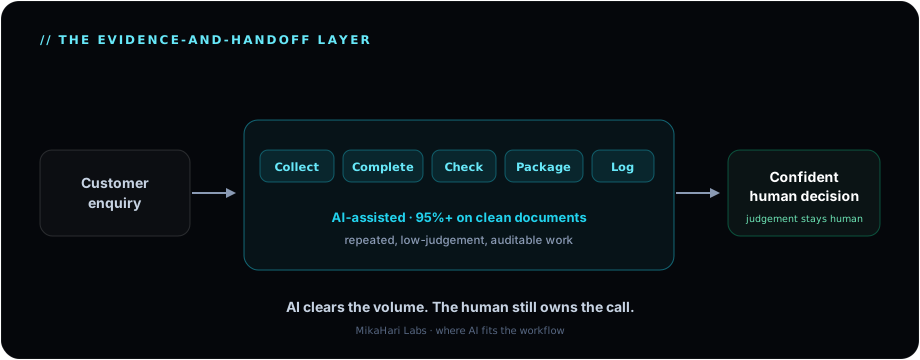
The first AI spend that pays back for a traditional UK SME is not a smarter decision engine. It is the removal of the four keystrokes nobody got paid for: the repeated document, evidence and handoff drag we call the evidence-and-handoff layer, the connective admin between a customer enquiry and a confident human decision. It costs the typical small-firm owner about four days a month and an average of £3,600 a year in tax-compliance help, rising to roughly £14,000 where the work is fully outsourced [2]. That work is high-volume, low-judgement and auditable, which is exactly why it is both the safest place to start and the place where the rules still expect a competent human to stay accountable and an audit trail to exist [7][8][9].
Owner and staff hours spent chasing documents, re-keying data, checking evidence and re-preparing the same narratives — over 33 hours, about four owner-days a month, on admin in a typical small firm.
The four keystrokes nobody got paid for
The four keystrokes nobody got paid for: any data entry a customer pays for the outcome of but never the act of. Type a client's date of birth into four lender portals and you have done it four times. That is the unit of waste this briefing is about, and it is the first thing AI should touch.
Picture it. A commercial finance broker types the same client's date of birth four times in one afternoon, once per lender portal. Nobody decided anything in those keystrokes. No judgement, no value added, no client advised; a number moved from one box to an identical box, four times over. That is not an edge case. It is the shape of the work that fills a traditional service SME's week, and AI should clear it long before anyone lets it near the actual advice.
Here is the bet this briefing is willing to lose on. Most SME AI advice tells you to buy a brain: a clever model that reasons, recommends, decides. We think the first payback is the opposite end of the building, the dullest and most-repeated task in it. If a firm that started with case-prep automation does not see a faster return than one that started with a 'decision assistant', the bet is wrong. The evidence below says it isn't.
“Type a client's date of birth into four lender portals and you have done it four times. That is the unit of waste this briefing is about.”
What this means: Point your first AI spend at the most-repeated keystroke, not the cleverest decision.
How big is the drag, really?
Big enough that you can size it without squinting. There were around 5.5 million private-sector businesses in the UK at the start of 2024, and 99.8% of them — roughly 5.49 million — were SMEs [1]. Tucked inside that figure are 754,000 firms in professional, scientific and technical activities: the accountants, brokers, consultants and advisers this briefing is written for [1]. These are not factories. Their raw material is paperwork.
And the paperwork is expensive in the one currency a small firm cannot mint more of: the owner's hours. The typical small-firm owner spends about four days a month, over 33 hours, on internal administration, and two in three say that load actively stops them doing what the business is for [2]. The same firms hand an average of £3,600 a year to someone else just for tax-compliance help, rising to roughly £14,000 where the work is fully outsourced [2]. Put the numbers side by side and the picture is blunt. The cost is not the decision at the end. It is the re-keying, the chasing and the re-narrating that surround it.
Why now — and why this and not the brain
AI adoption among UK SMEs has more than doubled in three years, and here is the tell: it landed on tasks, not headcount. British Chambers of Commerce research puts active AI use at 54% of firms in 2026, up from 35% in 2025, 25% in 2024 and 23% before that [3]. If AI were replacing people, you would see it in the payroll. You do not. More than nine in ten (95%) of SMEs using AI report no change in workforce size [3].
Where did the adoption actually go? It went to the drag, not to the decision. That is the whole argument in one statistic: firms are spending on AI to clear repeated low-value work and keep their people for the work that needs people. The window is open precisely because the tools are now good enough to take the volume, and the market has quietly agreed to point them at the admin first.
What can the document tools actually do, and where do they stop dead?
The relevant tool class has a name: intelligent document processing, meaning OCR plus classification, extraction, validation and hand-off. Its capability is split clean down the middle, and the split is not just marketing — it shows up in independent testing as well as vendor figures. On tidy digital PDFs with standard layouts, platforms like Rossum, Docsumo, Klippa and the hyperscaler services Google Document AI and AWS Textract land in the mid-to-high nineties for field-level accuracy, on a vendor overview of the tool class [4]. Hand them a phone-photographed bank statement, a handwritten note, or a non-standard form and that figure falls hard. A 2026 100-document benchmark by Braincuber put AWS Textract at 94.2% on printed text but just 71.2% on documents with handwritten notes, with Google Document AI close behind at 74.8% [5]. Cursive defeats them, bad penmanship defeats them, and reconciling the same fact across several document types stays genuinely hard.
So the working range an SME can plan around is roughly 95–98% on clean inputs falling to 70–85% on messy ones [4][5]. Which is why every grown-up deployment keeps a human on the exceptions: the low-confidence extractions, the judgement-heavy reconciliation, the odd clause, the quality sample. Nanonets is explicit that its agents 'read messy inputs, apply your rules' and route the hard ones onward rather than guessing [6]. The one-line read you can take to a buying decision: these tools clear the volume, they do not own the call. That split is not a flaw to engineer away. It is the load-bearing wall of the whole opportunity.
“These tools clear the volume, they do not own the call. That split is not a flaw to engineer away — it is the load-bearing wall of the whole opportunity.”
What this means: Buy the tools for the clean volume; keep a person on the messy 30% that breaks them.
Name the thing: the evidence-and-handoff layer
Give the opportunity a name and it stops being vague. The evidence-and-handoff layer is the connective admin between a customer enquiry and a confident human decision, running across five verbs: collect, complete, check, package, log. Those five are the spine of everything that follows, so name them once and watch for them everywhere. It is not the advice and it is not the form. It is everything that has to happen to a pile of documents before a competent person can responsibly say yes.
Watch it run in a real week. A broker gathers IDs, bank statements and accounts, chases the three that are missing, checks them against one lender's criteria, writes the case narrative, then does most of it again for the next lender. An accountancy practice re-asks the onboarding questions it half-asked last year, re-collects the documents, re-formats the same numbers for advisory prep. None of that is the thing the client pays for. All of it is the layer. And the layer is the part that sits in the mid-nineties on clean inputs while the decision it feeds stays stubbornly, correctly, human [4][5]. Clients will trust AI to prepare. They will not trust it to decide, and they are right not to.
Put a face on it. CCM (Carter Collins & Myer), a Rochdale accountancy practice serving around 600 clients, many of them smaller construction and incomplete-records businesses, says building a set of accounts from raw bank statements, once a full working day per client, now takes 60 to 90 minutes once the documents run through extraction (AutoEntry) into AccountsPrep. That is managing partner Rob Newman's own figure, from the vendor's case study [10]. A full day to ninety minutes is the layer being bought back, client by client.
Haven't the rules already drawn the line for you?
The convenient twist is that the regulators have spent the last two years drawing exactly the line the layer respects. ICAEW is explicit that AI supports professional work without replacing professional judgement, and that the accountant who signs it must understand and be able to explain the output [7]. The ICO is firm that where a decision is solely automated and carries a legal or similarly significant effect, any human involvement must be active rather than tokenistic, exercised by someone with the authority and competence to overturn the machine [8]. And under the FCA's Consumer Duty, the audit trail has been promoted from paperwork to primary compliance asset, because firms must evidence that they are delivering fair outcomes [9].
That is a green light, not a brake. Automate the five verbs while keeping a competent human accountable for the call and you are not fighting the rulebook; you are building the shape it asks for. The evidence-prep is where the machine genuinely helps; the human accountability is expected anyway; the log is now an asset you are required to keep. Three regulators, by three different routes, point the same way: keep a competent human accountable for the judgement, be able to explain it, and keep the evidence.
“That is a green light, not a brake. Automate the five verbs while keeping a competent human accountable for the call, and you are building the shape the rulebook asks for.”
What this means: The compliance line and the automation line are the same line — design to it, not around it.
MikaHari's view: start with the dullest task in the building
The verdict, plainly. Do not start your AI spend at the cleverest thing it can do; start at the most repeated thing you do. The volume is there: 5.49 million SMEs, four owner-days a month on admin, an average £3,600 a year on tax-compliance help [1][2]. The capability is there but bounded, mid-nineties on clean documents and human-required the moment it gets messy [4][5]. And the regulation actively rewards the accountable oversight and audit trail the layer preserves [7][8][9]. Three forces, one target: the evidence-and-handoff layer.
Get the sequence wrong and you can feel it within a quarter. Buy a decision engine, watch it stall on the messy 30% that needs a person, and the whole firm decides AI was oversold. Get it right and the gain is unglamorous on day one and undeniable by month three: an owner who stops re-keying, a case pack that builds itself to the human's desk, a log a regulator can read without a meeting. So pick the boring task on purpose. Let the machine do the four keystrokes; keep the person for the one decision they were always paid for. The brain was never the bottleneck — the keystrokes were, and those are the cheap thing to fix first.
What is the evidence-and-handoff layer?
It is the connective admin between a customer enquiry and a confident human decision — collect, complete, check, package, log. A broker assembling a lending case or a practice onboarding a client both run through it. The cost is the repetition and chasing in those five steps, not the final decision.
Will AI replace brokers, accountants or advisers?
Not on current evidence. 95% of UK SMEs using AI report no change in workforce size, and ICAEW, the ICO and the FCA each expect a competent human to stay accountable for the decisions that matter. AI is taking the admin around the judgement, not the judgement itself.
How accurate is AI at reading business documents?
On clean digital PDFs with standard layouts, intelligent document processing reaches the mid-to-high nineties for field-level accuracy, but this falls to roughly 70–85% on scanned, handwritten or unusual documents. An independent 100-document benchmark put AWS Textract at 94.2% on printed text and 71.2% on handwritten notes, with Google Document AI at 74.8% on handwriting. That gap is why mature setups keep humans for exceptions and reconciliation.
Where should an SME start with AI without breaking compliance?
Start with the highest-volume, lowest-judgement document task that already needs an audit trail — collection, completeness checks, evidence packaging — and keep a competent human accountable for the call, as the rules expect. That is both the safest and the highest-ROI entry point.






- Business population estimates for the UK and regions 2024 · GOV.UK / Dept for Business & Trade
- Half of SMEs using AI, with limited headcount impact so far · British Chambers of Commerce
- AI and accountants: support, not replacement, for professional judgement · ICAEW
- PRIN 2A — The Consumer Duty (monitoring customer outcomes) · FCA Handbook
- AWS Textract vs Google Document AI: 100-document OCR benchmark · Braincuber (independent benchmark)
- Compliance evidence packs: the AI price collapse and the Proof Tax · MikaHari Labs briefing
- Accountancy onboarding: why intake quality decides the year · MikaHari Labs briefing
- Vendor questionnaires and evidence requests: answer once, reuse everywhere · MikaHari Labs briefing
This briefing was researched and drafted by AI agents, then independently fact-checked before publishing. We show the workings so you can judge the quality yourself — not take our word for it.
- 1Researched + drafted · mikahari-briefing skill
- 2Humanised + GEO pass · editing agent
- 3Scored on soul + rigour · briefing-quality-scorer skill (independent)
- 4Fact-checked against sources · Codex, web-enabled (independent)
- 5Corrections applied · editing agent
Independently fact-checked: A web-enabled agent audited every cited statistic, named case and regulator claim against its source; flagged items were corrected before publishing. — Codex (independent), 18 June 2026.
Take this further.
If this briefing matches your workflow, start with the most specific move below — not a generic sales call.